Loading...

Coral

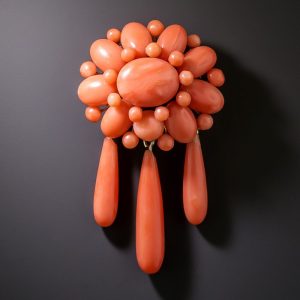
Victorian Coral Cluster and Pendant Brooch.

Coral is one of the very few organic gemstones. It consists of a mass of skeletons of tiny marine invertebrates that once lived in a colony attached to rocks or other objects on the ocean floor. The variety of coral that is of interest to jewelers and mystics is referred to as “precious coral”. It varies in color from blood red to a very pale pink. It occurs in tropical and subtropical oceans, usually at a depth of fewer than 50 feet, although there are some exceptions.

A Brief History of Coral

Since ancient times, the population surrounding the Mediterranean has used coral decoratively, medicinally, and spiritually. It flourishes around the coasts of Morocco, Corsica, and Algeria. The Romans hung pieces of coral around the necks of their children to protect them from illness and danger. Worn around a woman’s neck, it was a charm against sterility. Pliny tells of how coral was used to quiet tempests and ensure that the wearer would never be struck by lightning.

The ancient Chinese viewed coral as a symbol of longevity and official promotion. The ancient Greeks believed coral had the power to counteract witchcraft and protect against storms, poisons, and robbery.

Early in the 19th Century, the Navajo named coral one of the eighteen sacred objects, which is why it is common in Native American Jewels and ornaments.
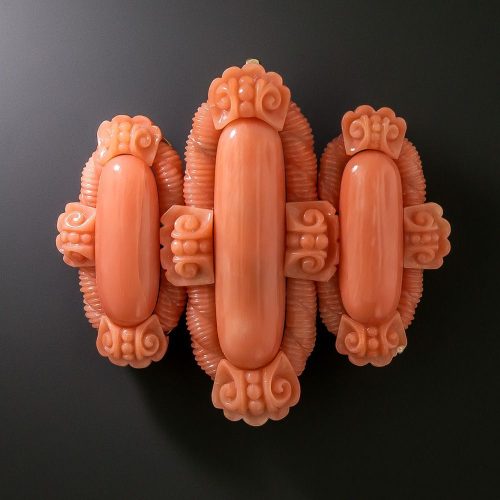
Victorian Carved Coral Brooch.
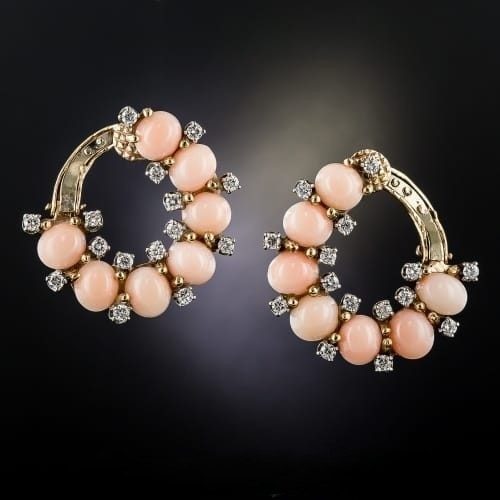
Mid-Century Hoop Style Coral and Diamond Ear Clips.
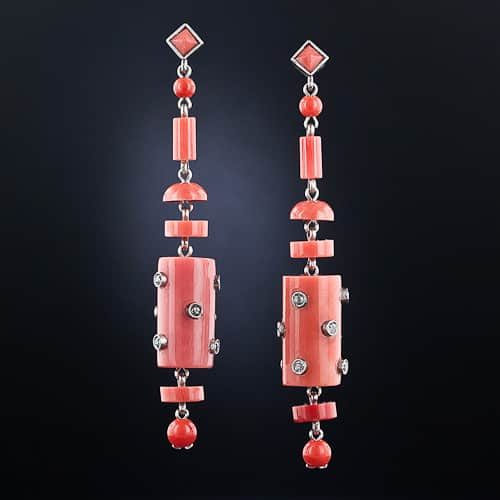
Art Deco Diamond and Coral Drop Earrings.

Eighteenth Century Italian Coral Colors

BiancoWhite
Pelle d’Angelo, Rosa Pallido, Rosa VivoPink
Rosso, Rosso Scuro, ArciscuroRed

Gemological Information for Coral

Color:Red, Orange, Pink, Peach, Black, Brown, Gold
Crystal Structure:Amorphous (organic)
Refractive Index:1.48-1.56
Durability:Soft and Fragile
Hardness:2.5-4
Family:
Similar Stones:Coral may be Mimicked by Glass, Plastics and Ceramics
Treatments:Dye
Country of Origin:Generally Between 30 Degrees Below and Above the Equator, Tropical to Sub-Tropical Waters

Coral Care

Ultrasonic Cleaning:Not Safe
Steam Cleaning:Not Safe
Warm Soapy Water:Not Safe, Use a Damp Cloth
Chemical Attack:Not Safe
Light Sensitivity:Sensitive
Heat Sensitivity:Not Safe

Shop at Lang

  • Mid-Century Coral Chrysanthemum Jade and Sapphire Brooch

    Mid-Century Coral Chrysanthemum Jade and Sapphire Brooch

    Here's a corsage fit for a prom queen! Measuring an impressive 3 inches by 2 1/4 inches, the multidimensional, angel skin pink colored Chrysanthemum flower is a…

    SHOP AT LANG
  • French Coral Three-Piece Necklace, Earring and Brooch Suite

    French Coral Three-Piece Necklace, Earring and Brooch Suite

    More typical of Victorian English or Italian provenance, we were pleasantly surprised to discover French hallmarks on this gorgeous, classic mid-nineteenth cent…

    SHOP AT LANG
  • Coral Cabochon Solitaire Ring

    Coral Cabochon Solitaire Ring

    A jubilant ocean gem--a gorgeous glossy vermilion-red cabochon coral, measuring 5/8 inch--is sitting pretty and gleams solo from high atop a fanciful open scrol…

    SHOP AT LANG
Further Resources
Gems & Gemology: The Quarterly Journal of The Gemological Institute of America.

Coral:

  • Spring 1950, Coral, the Forgotten Gem, by Copeland, p. 282, 6pp.
  • Fall 1959, Black Coral of Hawaii, p. 337, 1p.
  • Fall 1960, Black Coral of Hawaii, p. 72, 3pp.
  • Summer 1962, A White Coral Substitute, p. 304, 2pp.
  • Spring 1967, Black Coral Characteristics, p. 146, 1p.
  • Fall 1967, Dyed Angel-Skin Coral, p. 209, 1p.
  • Summer 1973, A Partly Silicified Coral, p. 182, 2pp.
  • Fall 1973, Hawaiian Black Coral, by Webster, p. 196, 3pp.
  • Fall 1973, Silicified Coral, p. 206, 2pp.
  • Fall 1973, Lapidary of Black Hawaiian Coral, p. 232, 1p.
  • Winter 1974, Blue Coral, p. 369, 2pp.
  • Winter 1974, Hawaiian Black Coral, but with a Golden Sheen, p. 369, 3pp.
  • Summer 1979, An Examination of the New Gilson “Coral,” by K. Nassau, p. 179, 7pp.
  • Winter 1979, Gold Corals – Some Thoughts on Their Discrimination, by Grahame Brown, p. 240, 5pp.
Close Menu
×